Sunday, September 10, 2006
Quote!
"pluralism... a passive response to more and more possibilities, none of which shall ever be practiced..." -David Tracy

If liberals can fuss about their title, than so can I...
... because "conservative" just doesn't capture it. Right now I am reading Mary Jo Weaver's "What's Left? Liberal American Catholics," and it is clear that she and her like-minded fellows have the impression that conservatives have something against change, as such.
This strikes me as funny, because if the Church were now ordaining women, permitting contraception, abortion, and sexual license, and dropping its doctrine of liturgy for a purely democratic model, it would be the liberals, not the conservatives, who would not want change.
Undoubtedly, loyalty to the magisterium is the only criterion a liberal needs to diagnose me as "conservative." But if they are so deeply concerned that they be represented correctly, why shouldn't I (and other "conservatives")? Not that I speak for others.
For myself, nostalgia has no part of my thinking. "Old" and "new" are neutral terms, and there are some things that are "new" that I find genuinely good for the Church, like Taize (at least in the implementations I have seen of it). Sometimes prayer needs to turn the brain off for a second and allow people to have an emotional encounter with a loving God--such was part of my religious formation in the first place. The nice thing about Taize is that it doesn't feel manipulative or imposing like Life Teen does. Taize is "introvert friendly", using darkness, silence, and mostly non-schmaltzy music to let emotions that are truly ours float to the surface (rather than imposing the "happy clappy").
Part of the problem is that I do not see the negative parts of modernity as really "new". "Modernity" itself is a constellation of three things: (1) wider consciousness of the state of the world, (2) the cultural triumph of nominalism over metaphysics, and (3) ancient emanationism. #1 is new; #2 is 500 years old; and #3 is at least 2500 years old. Nominalism and emanationism are both distorted variations on the doctrine of original sin. Emanationism views particularity, matter, and plurality as evil; thus it divinizes the salvific powers of the pure rational mind, which alone can transcend the corruption inherent in material nature. Nominalism reverses this: it develops a conviction of cognitive depravity (corruption inherent in the human mind) as a reaction against the excesses of corrupt metaphysics, and thus champions a constricted epistemology as a bulwark against error or subjectivism. Nominalism having developed into refined modern science, it takes up again the Greek theme of the infallibility of the mind, and develops a new rationalism, yet still constricted, hence a constricted view of "salvation" as strictly immanent.
(Quick definition. "Cognitive depravity" is the epistemic correlate to Calvin's "total depravity" [the first of the "TULIP" doctrines of Calvinism]. Cognitive depravity says that human minds are so broken by Original Sin and prone to error that we have absolutely no natural means to know God or any religious truths; thus theology cannot be a science. Although I need to study Ockham's Razor more, I strongly suspect a spiritual affinity between these two doctrines).
My view could be considered "conservative" against nominalism, as I seek to "conserve" a cautious metaphysics from the exaggerated paranoia surrounding cognitive depravity, thus criticizing the modern sciences' claim to a monopoly on credibility. But against emanationism I am not "conservative;" I am Christian; or perhaps more to the point, I believe in the Incarnation, according to which the Universal Absolute Ultimate has sanctified particularity, singularity, and finitude, which was never a tragic "last emanation" but a willed creation with a happy destiny and a necessary and real (Imago Dei) relationship with the will of the Creator (of which things like hierarchy and liturgy are a concrete manifestation).
Thus I critique the title "conservative." Instead, let me be called an incarnationalist metaphysician, or an analogical particularist; but not a conservative.
This strikes me as funny, because if the Church were now ordaining women, permitting contraception, abortion, and sexual license, and dropping its doctrine of liturgy for a purely democratic model, it would be the liberals, not the conservatives, who would not want change.
Undoubtedly, loyalty to the magisterium is the only criterion a liberal needs to diagnose me as "conservative." But if they are so deeply concerned that they be represented correctly, why shouldn't I (and other "conservatives")? Not that I speak for others.
For myself, nostalgia has no part of my thinking. "Old" and "new" are neutral terms, and there are some things that are "new" that I find genuinely good for the Church, like Taize (at least in the implementations I have seen of it). Sometimes prayer needs to turn the brain off for a second and allow people to have an emotional encounter with a loving God--such was part of my religious formation in the first place. The nice thing about Taize is that it doesn't feel manipulative or imposing like Life Teen does. Taize is "introvert friendly", using darkness, silence, and mostly non-schmaltzy music to let emotions that are truly ours float to the surface (rather than imposing the "happy clappy").
Part of the problem is that I do not see the negative parts of modernity as really "new". "Modernity" itself is a constellation of three things: (1) wider consciousness of the state of the world, (2) the cultural triumph of nominalism over metaphysics, and (3) ancient emanationism. #1 is new; #2 is 500 years old; and #3 is at least 2500 years old. Nominalism and emanationism are both distorted variations on the doctrine of original sin. Emanationism views particularity, matter, and plurality as evil; thus it divinizes the salvific powers of the pure rational mind, which alone can transcend the corruption inherent in material nature. Nominalism reverses this: it develops a conviction of cognitive depravity (corruption inherent in the human mind) as a reaction against the excesses of corrupt metaphysics, and thus champions a constricted epistemology as a bulwark against error or subjectivism. Nominalism having developed into refined modern science, it takes up again the Greek theme of the infallibility of the mind, and develops a new rationalism, yet still constricted, hence a constricted view of "salvation" as strictly immanent.
(Quick definition. "Cognitive depravity" is the epistemic correlate to Calvin's "total depravity" [the first of the "TULIP" doctrines of Calvinism]. Cognitive depravity says that human minds are so broken by Original Sin and prone to error that we have absolutely no natural means to know God or any religious truths; thus theology cannot be a science. Although I need to study Ockham's Razor more, I strongly suspect a spiritual affinity between these two doctrines).
My view could be considered "conservative" against nominalism, as I seek to "conserve" a cautious metaphysics from the exaggerated paranoia surrounding cognitive depravity, thus criticizing the modern sciences' claim to a monopoly on credibility. But against emanationism I am not "conservative;" I am Christian; or perhaps more to the point, I believe in the Incarnation, according to which the Universal Absolute Ultimate has sanctified particularity, singularity, and finitude, which was never a tragic "last emanation" but a willed creation with a happy destiny and a necessary and real (Imago Dei) relationship with the will of the Creator (of which things like hierarchy and liturgy are a concrete manifestation).
Thus I critique the title "conservative." Instead, let me be called an incarnationalist metaphysician, or an analogical particularist; but not a conservative.
Saturday, September 09, 2006
Collegiality and Depth in the Liturgy (Long and Short version)
Recently, my bishop ran an article in the local diocesan newspaper about divisions among Catholics about practices such as appropriate dress at Mass, music, and reverent silence. It was meant as a general exhortation to tolerance, patience, and inclusion; so naturally, this young upstart was inspired to offer a complementary note on depth and collegiality.
After I wrote the article, it was a full two pages long; the editor of the newspaper said that he liked it and wanted to publish it, but the limit for viewpoints was 350 words. So I butchered my own article down to size, and made enough modifications that it is worth putting both versions here.
Long Version
I was pleased to read Bishop Kicanas's article in the August edition of the New Vision, which addresses the divisions among the faithful regarding worship in Tucson parishes. While matters such as clothing, silence, and music may be the Pharisees' “tithes of mint and dill and cummin” compared to the “weightier things of the law: judgment and mercy and fidelity” (Matt 23:23), still it is good to know that Bishop does focus on the latter “without neglecting” the former. As a seminarian, I have some stake in the consensus of opinion within this diocese, so I wish to accept Bishop's invitation to comments and input.
Bishop Kicanas rightfully directs his article to the pastoral issues behind the disagreements themselves. How do we worship without alienating groups of the faithful, who hold their opinions in earnest and without blame? How can we recognize and honor the core truths that reside even within positions we may disagree with? No parish leaders, no matter their education, can dismiss these questions as illicit populism. A liturgy which ignores the cherished values of some of its participants risks either oppression, or worse, irrelevance—I say “worse” because an oppressive liturgy will at least strike indignation into the hearts of those offended (any passion is better than none at all). Irrelevance is the greater threat, because it stifles active participation and fails to nourish the subjective consciousness of the congregation. Irrelevant liturgy drains the community’s energy for “judgment and mercy and fidelity”. Moreover, no complaints will ensue, because one does not protest the irrelevant; he or she simply departs, or else attends out of sheer obligation, leaving the parish in silent discontent.
It thus hardly needs to be said that diversity presents pastors with a struggle: they must draw people into active participation in the mysteries of our salvation while inciting the least possible division. Yet there is also a priceless opportunity: for pastors, a community in controversy becomes a “school” of the human heart. It is true that listening to people (even the occasionally angry person) can be wearisome. But pastors who engage the laity and take them seriously will be rewarded with holy wisdom. This wisdom is no different essentially than that of Solomon—a depth of insight, informed from above and below, that can pierce the heart of controversy. How often have pastors felt that their parish's worship was like an infant being claimed by two mothers?
But this “school” cannot be a mere course in sociology. It is not enough to tally the numbers “yea” or “nay” regarding practices, and then rule accordingly. At best, this leads to unsatisfactory, 'middling' compromises and half-hearted tokens. The resulting truce will likely be uneasy and short-lived; and it also risks the problem of “Frankenstein” liturgies, tacked together from long-dead remains of past controversies. The liturgy should not be gambled with like the garment of Christ. No, this listening must be different from the “democratic” approach, or else it will risk (to extend the Solomon analogy) cutting the proverbial infant in two.
First, pastors should ask their parishioners not only what they want, but more importantly why. “Why?”—pertaining to theology, meaning, and experience; not just pragmatism—is the liturgical question. It is the door into depth; it brings the conversation to the level of values and understanding. Where politics seem to contradict, values are often shared, though in different orders and according to different presuppositions. “Why,” pushed to its limits, can turn a rehash of memorized arguments into a broad world of overlapping experiences and beliefs. In this respect, it behooves pastors and leaders to be Socratic in their approach; to be the “midwife” of the truth nascent in seeming contradictions. Yet the question “why” also links these things to the deepest “why” of the liturgy: the sacramental perpetuation of God's concrete saving act in Jesus Christ and the fulfillment of the promises of our Baptism. Even if pastors are unable to oblige certain external demands placed on the liturgy, they may still creatively honor what is good in the “why” of the original request.
Second, pastors should challenge the tendency of opponents to view their issues as opposite ends of a spectrum. Spectrum-thinking is not better than “black and white” thinking. They both methodically imply that competing perspectives have no nature independent of their negation of one-another. For example, with respect to proper dress during Mass, it is too easy to suppose that it is a debate between those who value internal holiness, versus those who prefer external observances. Yet this opposition is artificial. No one denies that God sees hearts before all else, for it is “the things that come out from within” by which we are judged (Mk 7:15). Yet if Jesus was stern with the Pharisees, the “whitewashed tombs,” he also warned those who “light a lamp and then put it under a bushel basket” (Mt 5:15). Are we hiding our awe and thanks to God, underneath an outfit (willfully chosen) not even suitable for common restaurants? Are we not thereby weakening the cultural currency of worship itself, leading young adults to wonder, 'why bother, for something so trivial?' Binary thinking forgets that the interior heart and the exterior witness were never meant to compete; Christ preached the unity of both in love of the Father. And neither is this a “compromise” or a “middle” position, but rather, it calls for a personal renewal of the virtues on both “sides”.
Third, pastors should take the data of their listening and place it in dialogue with time-tested wisdom about worship and human nature—not only from Scripture and Tradition, but from all of the classics of literature, philosophy, or even popular culture, which can exhibit razor sharp perception into the human soul. Yet this is also where a priest's seminary training and continuing formation come into play. The local church is not a closed system, forming opinions and views spontaneously out of the recesses of private judgment. Through media and popular slogans, the local church is already 'plugged in' to a network that mixes genuine wisdom and genuine corruptions. Pastors must plug into that same network, while also and always drawing on the riches of theology and the tradition of the Church. Here, tradition offers a unifying function, but not in the sense of forcibly cramming received opinions into stale formulas. Rather, tradition brings those opinions into a light which itself is not stilted or even formulaic, but is rather the summit of centuries of controversy, meditation, and prayer—cultivated from the same stuff as modern controversies, only refined, like aged wine.
Yet all of the dialogue in the world will not mend all of the divisions within a parish. Bishop Kicanas is right to point out that “we still can acknowledge the different perspectives, respect those who hold them and find ways to call people to make wise and appropriate judgments.” Yet two values we have as Catholics—respectful tolerance and zeal for excellence—cannot survive apart from each other. A central insight of Vatican II—part of its “spirit”—is that excellence can and should be discovered in a collegial way. But collegiality, rather than becoming itself the ultimate value, should be placed in the service of excellence and beauty, which can then draw people out of themselves and into the presence of God.
C.S. Lewis, in discussing “democratic education,” distinguished between “the education which democrats like” and the “education which will preserve democracy” (implying that these are quite different things). In a similar manner, if we desire a humanistic liturgy, we should distinguish between the “liturgy which humanists like”—if that means a mishmash of political concessions, and a “liturgy that sanctifies the human”—liturgy rooted in the Incarnate Christ, uniting the depths of the human spirit (deeply understood) to the height of revealed truth.
Short Version
How do Christians worship amid the mysteries of salvation without alienating groups of the faithful? How can we honor truth found even in ideas we find misguided? These questions are not mere populism: liturgy that ignores them risks division or irrelevance. But controversy can foster wisdom, not unlike that of King Solomon. How often have pastors felt that their parish's worship was like an infant claimed by two mothers?
The danger with consulting the faithful is that it risks becoming sociology, as if the liturgy were rooted in opinion polls. At best, this leads to disjointed “Frankenstein” liturgies, tacked together from long-dead remains of past controversies. The liturgy should not be gambled with like the garments of Christ. If liturgical consultation is not deeper than this, it will risk (per the Solomon analogy) cutting the proverbial infant in two. To mitigate against this risk, I have three modest suggestions.
First, pastors should ask their parishioners not only what they want, but more importantly about the meaning of what they want. “What does it mean?” is the liturgical question. Liturgy demands a Socratic approach; to seek the deeper truth nascent in seeming contradictions.
Second, pastors should challenge the tendency to view conflicting desires as opposites. It is too easy to suppose that the “Sunday dress debate” is about “internal holiness” versus “external observance”. This opposition is artificial—Jesus taught the union of both (read together Mk 7:15 and Mt 5:15).
Third, pastors should take the input and place it in dialogue with theology about worship and human nature. Popular culture already peddles both wisdom and corruption—no perspective comes from a void. Pastors must also consult the tradition of the Church. It helps to remember that tradition itself was harvested from controversies not unlike our own, only tested by time.
A central insight of Vatican II—part of its “spirit”—is that excellence should be discovered in a collegial way. But collegiality is not itself the ultimate value—it should serve excellence and beauty, which alone can draw people out of themselves and into the presence of God.
After I wrote the article, it was a full two pages long; the editor of the newspaper said that he liked it and wanted to publish it, but the limit for viewpoints was 350 words. So I butchered my own article down to size, and made enough modifications that it is worth putting both versions here.
Long Version
I was pleased to read Bishop Kicanas's article in the August edition of the New Vision, which addresses the divisions among the faithful regarding worship in Tucson parishes. While matters such as clothing, silence, and music may be the Pharisees' “tithes of mint and dill and cummin” compared to the “weightier things of the law: judgment and mercy and fidelity” (Matt 23:23), still it is good to know that Bishop does focus on the latter “without neglecting” the former. As a seminarian, I have some stake in the consensus of opinion within this diocese, so I wish to accept Bishop's invitation to comments and input.
Bishop Kicanas rightfully directs his article to the pastoral issues behind the disagreements themselves. How do we worship without alienating groups of the faithful, who hold their opinions in earnest and without blame? How can we recognize and honor the core truths that reside even within positions we may disagree with? No parish leaders, no matter their education, can dismiss these questions as illicit populism. A liturgy which ignores the cherished values of some of its participants risks either oppression, or worse, irrelevance—I say “worse” because an oppressive liturgy will at least strike indignation into the hearts of those offended (any passion is better than none at all). Irrelevance is the greater threat, because it stifles active participation and fails to nourish the subjective consciousness of the congregation. Irrelevant liturgy drains the community’s energy for “judgment and mercy and fidelity”. Moreover, no complaints will ensue, because one does not protest the irrelevant; he or she simply departs, or else attends out of sheer obligation, leaving the parish in silent discontent.
It thus hardly needs to be said that diversity presents pastors with a struggle: they must draw people into active participation in the mysteries of our salvation while inciting the least possible division. Yet there is also a priceless opportunity: for pastors, a community in controversy becomes a “school” of the human heart. It is true that listening to people (even the occasionally angry person) can be wearisome. But pastors who engage the laity and take them seriously will be rewarded with holy wisdom. This wisdom is no different essentially than that of Solomon—a depth of insight, informed from above and below, that can pierce the heart of controversy. How often have pastors felt that their parish's worship was like an infant being claimed by two mothers?
But this “school” cannot be a mere course in sociology. It is not enough to tally the numbers “yea” or “nay” regarding practices, and then rule accordingly. At best, this leads to unsatisfactory, 'middling' compromises and half-hearted tokens. The resulting truce will likely be uneasy and short-lived; and it also risks the problem of “Frankenstein” liturgies, tacked together from long-dead remains of past controversies. The liturgy should not be gambled with like the garment of Christ. No, this listening must be different from the “democratic” approach, or else it will risk (to extend the Solomon analogy) cutting the proverbial infant in two.
First, pastors should ask their parishioners not only what they want, but more importantly why. “Why?”—pertaining to theology, meaning, and experience; not just pragmatism—is the liturgical question. It is the door into depth; it brings the conversation to the level of values and understanding. Where politics seem to contradict, values are often shared, though in different orders and according to different presuppositions. “Why,” pushed to its limits, can turn a rehash of memorized arguments into a broad world of overlapping experiences and beliefs. In this respect, it behooves pastors and leaders to be Socratic in their approach; to be the “midwife” of the truth nascent in seeming contradictions. Yet the question “why” also links these things to the deepest “why” of the liturgy: the sacramental perpetuation of God's concrete saving act in Jesus Christ and the fulfillment of the promises of our Baptism. Even if pastors are unable to oblige certain external demands placed on the liturgy, they may still creatively honor what is good in the “why” of the original request.
Second, pastors should challenge the tendency of opponents to view their issues as opposite ends of a spectrum. Spectrum-thinking is not better than “black and white” thinking. They both methodically imply that competing perspectives have no nature independent of their negation of one-another. For example, with respect to proper dress during Mass, it is too easy to suppose that it is a debate between those who value internal holiness, versus those who prefer external observances. Yet this opposition is artificial. No one denies that God sees hearts before all else, for it is “the things that come out from within” by which we are judged (Mk 7:15). Yet if Jesus was stern with the Pharisees, the “whitewashed tombs,” he also warned those who “light a lamp and then put it under a bushel basket” (Mt 5:15). Are we hiding our awe and thanks to God, underneath an outfit (willfully chosen) not even suitable for common restaurants? Are we not thereby weakening the cultural currency of worship itself, leading young adults to wonder, 'why bother, for something so trivial?' Binary thinking forgets that the interior heart and the exterior witness were never meant to compete; Christ preached the unity of both in love of the Father. And neither is this a “compromise” or a “middle” position, but rather, it calls for a personal renewal of the virtues on both “sides”.
Third, pastors should take the data of their listening and place it in dialogue with time-tested wisdom about worship and human nature—not only from Scripture and Tradition, but from all of the classics of literature, philosophy, or even popular culture, which can exhibit razor sharp perception into the human soul. Yet this is also where a priest's seminary training and continuing formation come into play. The local church is not a closed system, forming opinions and views spontaneously out of the recesses of private judgment. Through media and popular slogans, the local church is already 'plugged in' to a network that mixes genuine wisdom and genuine corruptions. Pastors must plug into that same network, while also and always drawing on the riches of theology and the tradition of the Church. Here, tradition offers a unifying function, but not in the sense of forcibly cramming received opinions into stale formulas. Rather, tradition brings those opinions into a light which itself is not stilted or even formulaic, but is rather the summit of centuries of controversy, meditation, and prayer—cultivated from the same stuff as modern controversies, only refined, like aged wine.
Yet all of the dialogue in the world will not mend all of the divisions within a parish. Bishop Kicanas is right to point out that “we still can acknowledge the different perspectives, respect those who hold them and find ways to call people to make wise and appropriate judgments.” Yet two values we have as Catholics—respectful tolerance and zeal for excellence—cannot survive apart from each other. A central insight of Vatican II—part of its “spirit”—is that excellence can and should be discovered in a collegial way. But collegiality, rather than becoming itself the ultimate value, should be placed in the service of excellence and beauty, which can then draw people out of themselves and into the presence of God.
C.S. Lewis, in discussing “democratic education,” distinguished between “the education which democrats like” and the “education which will preserve democracy” (implying that these are quite different things). In a similar manner, if we desire a humanistic liturgy, we should distinguish between the “liturgy which humanists like”—if that means a mishmash of political concessions, and a “liturgy that sanctifies the human”—liturgy rooted in the Incarnate Christ, uniting the depths of the human spirit (deeply understood) to the height of revealed truth.
Short Version
How do Christians worship amid the mysteries of salvation without alienating groups of the faithful? How can we honor truth found even in ideas we find misguided? These questions are not mere populism: liturgy that ignores them risks division or irrelevance. But controversy can foster wisdom, not unlike that of King Solomon. How often have pastors felt that their parish's worship was like an infant claimed by two mothers?
The danger with consulting the faithful is that it risks becoming sociology, as if the liturgy were rooted in opinion polls. At best, this leads to disjointed “Frankenstein” liturgies, tacked together from long-dead remains of past controversies. The liturgy should not be gambled with like the garments of Christ. If liturgical consultation is not deeper than this, it will risk (per the Solomon analogy) cutting the proverbial infant in two. To mitigate against this risk, I have three modest suggestions.
First, pastors should ask their parishioners not only what they want, but more importantly about the meaning of what they want. “What does it mean?” is the liturgical question. Liturgy demands a Socratic approach; to seek the deeper truth nascent in seeming contradictions.
Second, pastors should challenge the tendency to view conflicting desires as opposites. It is too easy to suppose that the “Sunday dress debate” is about “internal holiness” versus “external observance”. This opposition is artificial—Jesus taught the union of both (read together Mk 7:15 and Mt 5:15).
Third, pastors should take the input and place it in dialogue with theology about worship and human nature. Popular culture already peddles both wisdom and corruption—no perspective comes from a void. Pastors must also consult the tradition of the Church. It helps to remember that tradition itself was harvested from controversies not unlike our own, only tested by time.
A central insight of Vatican II—part of its “spirit”—is that excellence should be discovered in a collegial way. But collegiality is not itself the ultimate value—it should serve excellence and beauty, which alone can draw people out of themselves and into the presence of God.
Theory, and a question
I recently had the thought that people who dissociate themselves from institutional religion do so for some combination of the seven following basic reasons:
UPDATE: I posted these in a MySpace thread, and got a few interesting replies. Actually, I thought that the main thing people would complain about was judgmentalism. But instead, the atheist/agnostic types said anti-intellectualism was the kicker.
- Judgmentalism and self-righteousness.
- Hypocrisy; wide gap between teaching and practice.
- Anti-intellectualism and anti-scientific, superstitious or mythological thinking.
- Shallow authoritarianism; cult mentality; lack of self-determination.
- Sentimentalism or schmaltz; childishness, inauthentic displays of "love" or "coolness".
- Coldness, heartlessness, unwelcoming.
- Irrelevant or out of touch; nothing substantial to offer to other sectors of life.
UPDATE: I posted these in a MySpace thread, and got a few interesting replies. Actually, I thought that the main thing people would complain about was judgmentalism. But instead, the atheist/agnostic types said anti-intellectualism was the kicker.
Ironical statement...
If it's one thing that all feminists hate, it's being lumped together as one group!
Funny as that is, I think it should be recognized as a dialogical courtesy to speak of "feminisms" rather than "feminism," and moreover, if a doctrine is referenced, to ascribe it to "certain feminisms" rather than "feminism." Now, this courtesy does not satisfy the complaint that certain such groups reject the moniker "feminist" altogether (e.g., womanists or mujeristas). But I find it more helpful to premise discussion with a disclaimer against total accuracy, than to invent an excessively wordy terminology which will (anyway) always fail to cover the whole breadth of opinions
On a related note, one of the central themes of certain feminisms is the task of "problematizing nature," or combatting the notion that any characteristics or traits are "naturally" feminine, and therefore, universal, normative, or binding.
Now, part of the difficult in liberal-conservative disputes is that the above doctrine involves a critique of how language has been corrupted into oppressive doctrines. Thus, if serious and level-headed conversation about that doctrine is to be possible, those participating need to understand that it is the very notion of nature which is in dispute.
Just as any good dictionary definition cannot include the defined term within its description, so a rational discussion of "nature" should avoid using the word among its premises. This is why certain feminists hold that their male dialogue partners are hopeless; because it is as difficult to avoid implying the concept of "nature" as it is not to use the word "thing" or "the."
My modest proposal is that, in discussions about whether any generalities can be made based off of observations of disparate data in our environs, it would be helpful to speak of that which is "common" rather than that which is "natural." The debate, after all, is whether "the common" and "the natural" are correlated in any way. Note that this is a methodological, not ideological concession. Of course, methodology and ideology cannot be wholly separated (which is my critique of the "hermenuetics of suspicion"); but since stating that things are "natural" begs the question in the dispute between existential feminism and naturalism, beginning with the "common" I think is proper.
Funny as that is, I think it should be recognized as a dialogical courtesy to speak of "feminisms" rather than "feminism," and moreover, if a doctrine is referenced, to ascribe it to "certain feminisms" rather than "feminism." Now, this courtesy does not satisfy the complaint that certain such groups reject the moniker "feminist" altogether (e.g., womanists or mujeristas). But I find it more helpful to premise discussion with a disclaimer against total accuracy, than to invent an excessively wordy terminology which will (anyway) always fail to cover the whole breadth of opinions
On a related note, one of the central themes of certain feminisms is the task of "problematizing nature," or combatting the notion that any characteristics or traits are "naturally" feminine, and therefore, universal, normative, or binding.
Now, part of the difficult in liberal-conservative disputes is that the above doctrine involves a critique of how language has been corrupted into oppressive doctrines. Thus, if serious and level-headed conversation about that doctrine is to be possible, those participating need to understand that it is the very notion of nature which is in dispute.
Just as any good dictionary definition cannot include the defined term within its description, so a rational discussion of "nature" should avoid using the word among its premises. This is why certain feminists hold that their male dialogue partners are hopeless; because it is as difficult to avoid implying the concept of "nature" as it is not to use the word "thing" or "the."
My modest proposal is that, in discussions about whether any generalities can be made based off of observations of disparate data in our environs, it would be helpful to speak of that which is "common" rather than that which is "natural." The debate, after all, is whether "the common" and "the natural" are correlated in any way. Note that this is a methodological, not ideological concession. Of course, methodology and ideology cannot be wholly separated (which is my critique of the "hermenuetics of suspicion"); but since stating that things are "natural" begs the question in the dispute between existential feminism and naturalism, beginning with the "common" I think is proper.
Thursday, September 07, 2006
I rather dislike the word "postmodern"
I recently read James KA Smith's "Who's Afraid of Postmodernism," and I have to say, I've just grown tired of the word.
It seems ridiculous to me that we are always struggling with the concept of two postmodernism: the "bad kind," which is nothing more than the not-quite-radical-enough radicalization of modernism; and the "good kind," which not only deconstructs deconstructionism, but deconstructs the deconstruction of deconstructionism. "Good postmodernism" discovers the ontotheological nature not only of modernity but also its pretentious offspring, and discovers that the intellectual world after Ockham has seen an amputation, not a growth, of human thought.
I don't like talking about "good postmodernism" vs. "bad postmodernism" because the latter is not really "post" and the former is not really "modern". I believe that the prefix we should be using, is not "post" but "neo" - indicating a modification, in light of historical developments, without an essential change of direction.
"Bad postmodernism" is really just neo-modenrism (unfortunately, the word is already taken to mean something different than I intend).
"Good postmodernism" one might call neo-pre-modernism, which basically just disregards nominalism as a valid turn in human thought.
It seems ridiculous to me that we are always struggling with the concept of two postmodernism: the "bad kind," which is nothing more than the not-quite-radical-enough radicalization of modernism; and the "good kind," which not only deconstructs deconstructionism, but deconstructs the deconstruction of deconstructionism. "Good postmodernism" discovers the ontotheological nature not only of modernity but also its pretentious offspring, and discovers that the intellectual world after Ockham has seen an amputation, not a growth, of human thought.
I don't like talking about "good postmodernism" vs. "bad postmodernism" because the latter is not really "post" and the former is not really "modern". I believe that the prefix we should be using, is not "post" but "neo" - indicating a modification, in light of historical developments, without an essential change of direction.
"Bad postmodernism" is really just neo-modenrism (unfortunately, the word is already taken to mean something different than I intend).
"Good postmodernism" one might call neo-pre-modernism, which basically just disregards nominalism as a valid turn in human thought.
Wednesday, September 06, 2006
Imitation in worship and the imitation of worship.
I have written before about my misgivings about the integration of certain kinds of technology into the liturgy. It is difficult to express these misgivings to most people, first of all because the stronger ethos is decidedly in favor of technology everywhere it mitigates against inconveniences; and second, because the charge of hypocrisy is the prescribed medication for any modern with apparently luddite leanings. How stupid of me to write a diatribe against technology on Blogger!
But the patient listener will, perhaps, sit with me a while and learn that my complaint against liturgical technology is neither absolutist, aribtrarily prejudicial, or without the proper distinctions. I say "arbibrarily" because "prejudice" by itself is nothing more than the pejorative synonym for principle. All principles are prejudicial by their very nature; that is their function--to formulate a relatively stable structure of how values may interact with abstract qualities of manifold circumstances, in order to make the process of judgment easier. (Does this mean that all morality can be reduced to casuistry? More on that later!)
This post only points out one aspect of technology that is problematic. I believe that this aspect is sufficiently concrete to be preserved from accusations of being a mere rationalization of my private tastes. That aspect is the mimetic quality of technology. As a central example, I will be referring to the case of oil-lit candles. The issue is complex enough that I will have to consciously structure it.
An important question that some will raise is how one can make a concrete categorical distinction between wax candles and oil candles. Both are, after all, technology in the strict sense--wax candles are no less manufactured than gas candles; they do not grow on trees. If gas candles accomplish the same task as wax candles with less mess, inexpensive maintenance, and more convenient storage, why would they constitute an essentially different thing than any legitimate technological development? After all, candles did not always use wax; is a wax candle an illegitimate "mimetic" form of the tallow candle? Maybe oil candles will someday become the norm, and further on, when they are replaced by something else, another seminarian will complain that the newfangled "candles" are not really candles because they do not burn from containers of oil.
What makes oil-lit candles mimetic is not primarily the fact that they use a different technology than wax candles. After all, in the realm of portable light, oil lamps did replace wax candles. But they did not go out of their way, thereafter, to mimic the look or feel of candles. Earlier, when wax began to replace tallow as candle material, the similarity between use of the new material and the old was not a self-conscious contraption meant to distract away from the difference--they just happened to be very similar materials.
What makes oil-lit candles in churches mimetic is the self-conscious attempt, in their manufacture and deployment, to make them appear as though they were actually wax candles--again, not to deceive, but to make their oil-lit nature relatively invisible and unremarkable. There is, in that very practice, a tacit admission that something valuable would be lost if the oil-lit flames by the altar were not disguised at all, and clearly showed their oil-lit nature to the world, such that they could hardly be called "candles" anymore, but rather, the lamps that they in fact are.
Now, as far as I know, the Church does not yet have a highly developed mystagogy for the significance of candles; they are symbols of the light of Christ. Yet although the Magisterium has not (to my knowledge) explicitly forbidden the use of 70 Watt incandescent light bulbs instead of candles, few priests are jumping on that opportunity. The use of candles might just be sentimental or sheer tradition (as in, without a rationalistic foundation). Yet if one had to grasp, I would suggest that we have no other way to so eloquently domesticate fire while retaining its most commonly (i.e. naturally) occurring wildness and unpredictability of movement--a sort of retroactive reference back to Christ's own enthusiasm for wildfires--"I have come to set the earth on fire, and how I wish it were already blazing!" (Lk 12:49).
But the issue at present is not whether candles are inherently better than oil lamps for liturgy, but what to make of oil lamps pretending to be candles--as well as other instances of technological "pretending".
Continuing on...
Still, one other important distinction must be made. Even if people are persuaded that mimetic technology is not simply an improvement of technology, one may be tempted to ask, what is wrong with imitation? After all, the best of art imitates nature. Is not mimetic technology just another example of such plastic arts? What about those gothic columns I am so fond of, that look like trees branching out into the archways? Who is to say that lamps cannot imitate candles (and plastic, plants; and computers, pianos) when human art has always been imitative in one form or another?
The distinction between mimetic technology and mimetic art is more subtle, but I believe it is real. The fundamental difference is that real art tends to draw attention toward its representative nature; mimetic technology tends to draw your attention away from its imitative nature.
The value of art resides precisely in its being an artistic representation. It wants you to dwell on its "artificiality", not to believe or pretend that it is what it represents, but to contemplate what it is saying about its subject. In other words, there is an intentional distance between the artwork and its subject, wherein meaning rests. Something is not merely being imitated here, it is being glorified, or villified, or even simply represented, but even then to draw your attention beyond the physical object and onto the subject and its meaning.
Mimetic technology is quite a different animal. On one hand, oil lamp-candles are not gesturing beyond themselves at all; the intention is not to inspire contemplation on the nature or meaning of candles or anything else. Their self-same object is their only referent--"I am a candle!" However, ironically, the oil-lit candles are most effective when they are not looked at too closely; blur your vision a little and their differences from real candles are not so apparent. Yet who blurs their vision to appreciate art?
Consider that a single object might be both mimetic technology and mimetic art; say, an oil candle shaped like the graceful columns of the baldechino in St. Peter's Basilica. Such a thing would have a strange, almost contradictory effect: at the same time naturally guiding the eye along its lively curves, and shutting out the mind's perception that those curves are machine-molded plastic, not wax. The subjective effect is one of frustration, like being fed air. The eyes blanch at the transparent Chi-Rho stickers on the small oil-candles flanking the tabernacle.
What is happening here? What is the inner logic of mimetic technology?
Third installment:
If anyone were to bring up a complaint about the use of mimetic technology (or "fake things") in church, the response of the pastor would probably go along the following lines: they do the same things as their counterparts, while being at the same time easier to maintain, cheaper, and perhaps even safer. Indeed, one needs to look closely, in some instances, to determine whether a plant is fake; and no one denies that oil-lit candles are cheaper and cleaner than their wax counterparts. The force of pragmatism is a difficult opponent to challenge in disputes, because even if the use of 'real' artifacts provided some nebulous advantage, that advantage would seem to be too intangible to mobilize an effective counter-value.
Perhaps part of what is needed to do precisely that, is a deeper understanding of the dynamic of mimetic technology. We have to delve into the assumptions that make mimetic technology valuable and ask whether those assumptions do justice to the complete truth of the human person in the act of worshipping God. We have to "over-analyze," and never fear the accusation thereof, because analysis which stops short on account of the virtue of moderation, also stops short of truth.
The very conceptual possibility of mimetic technology is based on a conviction of a hard subject-object split. The irrevocable distance between the observer and the “thing in itself” creates a gap, which then puts to question the claim of the subject to have privileged access (or even, any access at all) to the thing on the basis of perception alone. Postmodernism takes this problem and shifts the focus: the goal is not to discover what the thing really is (which is certainly impossible) but to instead live in the world of perception alone, without the 'myth' of objective referents. Our very act of perception changes the object, such that it is the perceiving, and not the object at all, which is and has always been the center of human meaning.
The substitution of one objective locus of perceived phenomena for another is thus truly irrelevant; the less it affects our subjective impressions, the less relevant it is. Nominalism is the mandate for the cultivation of an increasingly virtual reality, which at the same time (a) disavows difference between itself and “real reality,” and yet (b) conforms itself ever more radically to our needs, desires, fears, and values. The latter process is true of how all technology affects our lives; but the former is true especially of mimetic technology. This dual process naturally fosters easy acclimatization to itself, even to the degree that those few who are ever mindful of a past pre-virtualization of their world may no longer have a clear sense of how it was different; what were the genuine advantages and disadvantages it held.
Full-on nominalism would have us believe that there is no such difference between the present “virtual” and the past “real”; the “real” is merely a fetish; everything, in the end, is and always has been “virtual,” lacking the objectivity which we all attributed to it as children. The mark of maturity is to understand how little we actually share in common, with our different subjectivities, and that too enthusiastic a devotion to vacuous terms like the “real,” “actual,” “factual,” and “objective” is not only unhealthy—if it is not sufficiently Kantian, it is downright oppressive.
The Freedom vs. Determinism connection
Another human controversy follows this pattern almost exactly, so I am going to shift gears away from the question of “reality” and toward the related question of “freedom.” When the common pattern is established, I will make a double-application to both cases in order to deconstruct nominalism.
Determinism is a major philosophical problem, and it has not gone away with the discovery of an indeterminate quantum substrata beneath atomistic physics. Quantum physics does not erase determinism; it just makes determinism very unpredictable. The question behind the dilemma of human free will was never, in the end, about human predictability according to natural laws—but rather about whether or not the human being has an autonomy of choice which is, not illusory, but real.
The special difficulty of the problem is that one cannot “step outside” the experience of life in order to verify that his freedom is true. A microscope tells us nothing about itself as a microscope; even if it were made of rubber, it could not twist upon itself to analyze itself and given us a self image that gave us any new information. Similarly, our “freedom”, or our experience of freedom, is presupposed by our very act of discussing it—we cannot not act as if we were not free.
The impossibility of proving free will itself is not the greatest obstacle to believing in objective freedom, but it combines with relative predictability—i.e., unfreedom—of the rest of the natural universe and fails to find a scientific ground for our essential difference from that universe. The psychological sciences' demonstrations that we participate, in varying degrees, in that natural predictability seems to nail the coffin.
Yet the key phrase here is “varying degrees.” Psychology and sociology have never been quite able to put a finger on human behavior, and their 'laws' have always been the least stable of any of the modern sciences, whatever substance they actually have. This anomaly has an experiential correlate in our individual encounters with varying degrees of “freedom.” The addict and the monk have polar opposites of this... this "whatever," and though we choose to call it "freedom," we still cannot say in an absolute sense that the monk's seeming non-determinedness is not illusory.
However, even if it was illusory, we cannot contradict the vast difference of the “whatever” it is the monk has and the addict lacks. The monk can drink a beer; the addict cannot not drink a beer. While it is true that these poles are not absolute—the monk has compulsions and the addict has a will—yet still a definite difference of degree is present. This difference cannot prove freedom in a metaphysical way; but what it does do is prove freedom in an immanent and undeniable, if merely functional way.
Analytic philosophers have already explored this corner of the jungle, and most, I imagine, have left at this juncture. We must be satisfied to act “as if we were free”, and any further speculation about absolutely existent, objective freedom is literally non-sense. I am not so satisfied, but what I have shown here is sufficient for our purposes in dealing with objective reality and mimetic technology, so we can move on.
Nominalism closes off our access to “objective reality” in an absolute sense. Like the case of freedom, we cannot “step out of” our subjectivity to view the world in a way unmediated by subjectivity. But, so also with freedom, “reality” and “unreality” are relative experiences we have, even within our all-encompassing subjectivity. These experiences are undeniable, even by the thoroughgoing nominalist, though he will try to persuade us that there may be nothing at all “beneath” that difference; no objective substance to our relative subjective experience of objectivity.
The correspondence theory of truth did not manifest out of thin air, or out of hopes and dreams; it is a metaphysical analogue to physical experiences, according to which 'objective' things are identical or different from one-another, or themselves illusory in a verifiable way. The identity of a candle with itself is not an illusion, and its difference from an oil lamp is not an illusion; even if every concept of objectivity were an illusion, yet we then must have illusions of realities vs. illusions of illusions.
The point is that nominalism cannot erase the functional reality of different degrees of objectivity any more than determinism can eliminate the experienced reality of different degrees of freedom.
But that having been established: why, if our subjectivity detects little difference, are objective candles preferable to candles-in-appearance-only?
To be answered tomorrow!
G.K. Chesterton wrote, "Pragmatism is a matter of human needs; and one of the first of human needs is to be something more than a pragmatist."
But the patient listener will, perhaps, sit with me a while and learn that my complaint against liturgical technology is neither absolutist, aribtrarily prejudicial, or without the proper distinctions. I say "arbibrarily" because "prejudice" by itself is nothing more than the pejorative synonym for principle. All principles are prejudicial by their very nature; that is their function--to formulate a relatively stable structure of how values may interact with abstract qualities of manifold circumstances, in order to make the process of judgment easier. (Does this mean that all morality can be reduced to casuistry? More on that later!)
This post only points out one aspect of technology that is problematic. I believe that this aspect is sufficiently concrete to be preserved from accusations of being a mere rationalization of my private tastes. That aspect is the mimetic quality of technology. As a central example, I will be referring to the case of oil-lit candles. The issue is complex enough that I will have to consciously structure it.
- The difference between mimetic technology and technological development.
- The difference between mimetic technology and mimetic art.
- The realism vs. nominalism connection.
- The freedom vs. determinism connection.
- How mimetic technology shapes perception and experience in the liturgy.
- Concrete examples.
- General principles.
An important question that some will raise is how one can make a concrete categorical distinction between wax candles and oil candles. Both are, after all, technology in the strict sense--wax candles are no less manufactured than gas candles; they do not grow on trees. If gas candles accomplish the same task as wax candles with less mess, inexpensive maintenance, and more convenient storage, why would they constitute an essentially different thing than any legitimate technological development? After all, candles did not always use wax; is a wax candle an illegitimate "mimetic" form of the tallow candle? Maybe oil candles will someday become the norm, and further on, when they are replaced by something else, another seminarian will complain that the newfangled "candles" are not really candles because they do not burn from containers of oil.
What makes oil-lit candles mimetic is not primarily the fact that they use a different technology than wax candles. After all, in the realm of portable light, oil lamps did replace wax candles. But they did not go out of their way, thereafter, to mimic the look or feel of candles. Earlier, when wax began to replace tallow as candle material, the similarity between use of the new material and the old was not a self-conscious contraption meant to distract away from the difference--they just happened to be very similar materials.
What makes oil-lit candles in churches mimetic is the self-conscious attempt, in their manufacture and deployment, to make them appear as though they were actually wax candles--again, not to deceive, but to make their oil-lit nature relatively invisible and unremarkable. There is, in that very practice, a tacit admission that something valuable would be lost if the oil-lit flames by the altar were not disguised at all, and clearly showed their oil-lit nature to the world, such that they could hardly be called "candles" anymore, but rather, the lamps that they in fact are.
Now, as far as I know, the Church does not yet have a highly developed mystagogy for the significance of candles; they are symbols of the light of Christ. Yet although the Magisterium has not (to my knowledge) explicitly forbidden the use of 70 Watt incandescent light bulbs instead of candles, few priests are jumping on that opportunity. The use of candles might just be sentimental or sheer tradition (as in, without a rationalistic foundation). Yet if one had to grasp, I would suggest that we have no other way to so eloquently domesticate fire while retaining its most commonly (i.e. naturally) occurring wildness and unpredictability of movement--a sort of retroactive reference back to Christ's own enthusiasm for wildfires--"I have come to set the earth on fire, and how I wish it were already blazing!" (Lk 12:49).
But the issue at present is not whether candles are inherently better than oil lamps for liturgy, but what to make of oil lamps pretending to be candles--as well as other instances of technological "pretending".
Continuing on...
Still, one other important distinction must be made. Even if people are persuaded that mimetic technology is not simply an improvement of technology, one may be tempted to ask, what is wrong with imitation? After all, the best of art imitates nature. Is not mimetic technology just another example of such plastic arts? What about those gothic columns I am so fond of, that look like trees branching out into the archways? Who is to say that lamps cannot imitate candles (and plastic, plants; and computers, pianos) when human art has always been imitative in one form or another?
The distinction between mimetic technology and mimetic art is more subtle, but I believe it is real. The fundamental difference is that real art tends to draw attention toward its representative nature; mimetic technology tends to draw your attention away from its imitative nature.
The value of art resides precisely in its being an artistic representation. It wants you to dwell on its "artificiality", not to believe or pretend that it is what it represents, but to contemplate what it is saying about its subject. In other words, there is an intentional distance between the artwork and its subject, wherein meaning rests. Something is not merely being imitated here, it is being glorified, or villified, or even simply represented, but even then to draw your attention beyond the physical object and onto the subject and its meaning.
Mimetic technology is quite a different animal. On one hand, oil lamp-candles are not gesturing beyond themselves at all; the intention is not to inspire contemplation on the nature or meaning of candles or anything else. Their self-same object is their only referent--"I am a candle!" However, ironically, the oil-lit candles are most effective when they are not looked at too closely; blur your vision a little and their differences from real candles are not so apparent. Yet who blurs their vision to appreciate art?
Consider that a single object might be both mimetic technology and mimetic art; say, an oil candle shaped like the graceful columns of the baldechino in St. Peter's Basilica. Such a thing would have a strange, almost contradictory effect: at the same time naturally guiding the eye along its lively curves, and shutting out the mind's perception that those curves are machine-molded plastic, not wax. The subjective effect is one of frustration, like being fed air. The eyes blanch at the transparent Chi-Rho stickers on the small oil-candles flanking the tabernacle.
What is happening here? What is the inner logic of mimetic technology?
Third installment:
If anyone were to bring up a complaint about the use of mimetic technology (or "fake things") in church, the response of the pastor would probably go along the following lines: they do the same things as their counterparts, while being at the same time easier to maintain, cheaper, and perhaps even safer. Indeed, one needs to look closely, in some instances, to determine whether a plant is fake; and no one denies that oil-lit candles are cheaper and cleaner than their wax counterparts. The force of pragmatism is a difficult opponent to challenge in disputes, because even if the use of 'real' artifacts provided some nebulous advantage, that advantage would seem to be too intangible to mobilize an effective counter-value.
Perhaps part of what is needed to do precisely that, is a deeper understanding of the dynamic of mimetic technology. We have to delve into the assumptions that make mimetic technology valuable and ask whether those assumptions do justice to the complete truth of the human person in the act of worshipping God. We have to "over-analyze," and never fear the accusation thereof, because analysis which stops short on account of the virtue of moderation, also stops short of truth.
The very conceptual possibility of mimetic technology is based on a conviction of a hard subject-object split. The irrevocable distance between the observer and the “thing in itself” creates a gap, which then puts to question the claim of the subject to have privileged access (or even, any access at all) to the thing on the basis of perception alone. Postmodernism takes this problem and shifts the focus: the goal is not to discover what the thing really is (which is certainly impossible) but to instead live in the world of perception alone, without the 'myth' of objective referents. Our very act of perception changes the object, such that it is the perceiving, and not the object at all, which is and has always been the center of human meaning.
The substitution of one objective locus of perceived phenomena for another is thus truly irrelevant; the less it affects our subjective impressions, the less relevant it is. Nominalism is the mandate for the cultivation of an increasingly virtual reality, which at the same time (a) disavows difference between itself and “real reality,” and yet (b) conforms itself ever more radically to our needs, desires, fears, and values. The latter process is true of how all technology affects our lives; but the former is true especially of mimetic technology. This dual process naturally fosters easy acclimatization to itself, even to the degree that those few who are ever mindful of a past pre-virtualization of their world may no longer have a clear sense of how it was different; what were the genuine advantages and disadvantages it held.
Full-on nominalism would have us believe that there is no such difference between the present “virtual” and the past “real”; the “real” is merely a fetish; everything, in the end, is and always has been “virtual,” lacking the objectivity which we all attributed to it as children. The mark of maturity is to understand how little we actually share in common, with our different subjectivities, and that too enthusiastic a devotion to vacuous terms like the “real,” “actual,” “factual,” and “objective” is not only unhealthy—if it is not sufficiently Kantian, it is downright oppressive.
The Freedom vs. Determinism connection
Another human controversy follows this pattern almost exactly, so I am going to shift gears away from the question of “reality” and toward the related question of “freedom.” When the common pattern is established, I will make a double-application to both cases in order to deconstruct nominalism.
Determinism is a major philosophical problem, and it has not gone away with the discovery of an indeterminate quantum substrata beneath atomistic physics. Quantum physics does not erase determinism; it just makes determinism very unpredictable. The question behind the dilemma of human free will was never, in the end, about human predictability according to natural laws—but rather about whether or not the human being has an autonomy of choice which is, not illusory, but real.
The special difficulty of the problem is that one cannot “step outside” the experience of life in order to verify that his freedom is true. A microscope tells us nothing about itself as a microscope; even if it were made of rubber, it could not twist upon itself to analyze itself and given us a self image that gave us any new information. Similarly, our “freedom”, or our experience of freedom, is presupposed by our very act of discussing it—we cannot not act as if we were not free.
The impossibility of proving free will itself is not the greatest obstacle to believing in objective freedom, but it combines with relative predictability—i.e., unfreedom—of the rest of the natural universe and fails to find a scientific ground for our essential difference from that universe. The psychological sciences' demonstrations that we participate, in varying degrees, in that natural predictability seems to nail the coffin.
Yet the key phrase here is “varying degrees.” Psychology and sociology have never been quite able to put a finger on human behavior, and their 'laws' have always been the least stable of any of the modern sciences, whatever substance they actually have. This anomaly has an experiential correlate in our individual encounters with varying degrees of “freedom.” The addict and the monk have polar opposites of this... this "whatever," and though we choose to call it "freedom," we still cannot say in an absolute sense that the monk's seeming non-determinedness is not illusory.
However, even if it was illusory, we cannot contradict the vast difference of the “whatever” it is the monk has and the addict lacks. The monk can drink a beer; the addict cannot not drink a beer. While it is true that these poles are not absolute—the monk has compulsions and the addict has a will—yet still a definite difference of degree is present. This difference cannot prove freedom in a metaphysical way; but what it does do is prove freedom in an immanent and undeniable, if merely functional way.
Analytic philosophers have already explored this corner of the jungle, and most, I imagine, have left at this juncture. We must be satisfied to act “as if we were free”, and any further speculation about absolutely existent, objective freedom is literally non-sense. I am not so satisfied, but what I have shown here is sufficient for our purposes in dealing with objective reality and mimetic technology, so we can move on.
Nominalism closes off our access to “objective reality” in an absolute sense. Like the case of freedom, we cannot “step out of” our subjectivity to view the world in a way unmediated by subjectivity. But, so also with freedom, “reality” and “unreality” are relative experiences we have, even within our all-encompassing subjectivity. These experiences are undeniable, even by the thoroughgoing nominalist, though he will try to persuade us that there may be nothing at all “beneath” that difference; no objective substance to our relative subjective experience of objectivity.
The correspondence theory of truth did not manifest out of thin air, or out of hopes and dreams; it is a metaphysical analogue to physical experiences, according to which 'objective' things are identical or different from one-another, or themselves illusory in a verifiable way. The identity of a candle with itself is not an illusion, and its difference from an oil lamp is not an illusion; even if every concept of objectivity were an illusion, yet we then must have illusions of realities vs. illusions of illusions.
The point is that nominalism cannot erase the functional reality of different degrees of objectivity any more than determinism can eliminate the experienced reality of different degrees of freedom.
But that having been established: why, if our subjectivity detects little difference, are objective candles preferable to candles-in-appearance-only?
To be answered tomorrow!
G.K. Chesterton wrote, "Pragmatism is a matter of human needs; and one of the first of human needs is to be something more than a pragmatist."
Tuesday, September 05, 2006
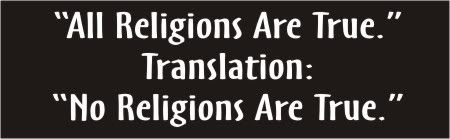
New sticker and self-critique
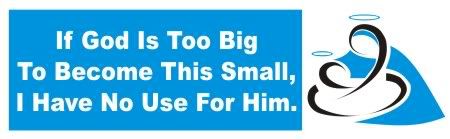
I did this bumper sticker as a companion to a bulletin article I wrote today, again, as an apologetical response to the bumper sticker "God Is Too Big To Fit Into Just One Religion." In the article, I basically point out that God of Christianity is beyond "big" and "small" and encompasses both the universal and the particular. At one point, I wrote, "Is God too big to become small? I have no use for that god." My real point was that it is the Incarnation, and everything that comes with it (including a Church which is a visible society) that truly make God relevant and reveal his unsurpassable glory.
The sticker above uses a conveniently pre-designed template from makestickers.com. I have two things to say against it. Liberals are likely to love it, first of all because it makes God into a harmless, and hence non-challenging being. Liberals do not like the idea of a God that is absolutely higher than us and our judge, and so this sticker could play into their antinomialism. The second thing that's wrong with this sticker is that it applies the word "use" to God. This is a lesser problem, since I was, after all, only pointing out the inherent irrelevance of the pluralist "god". But it evokes the pragmatist sense of religion, which is always bad.
Sunday, September 03, 2006


Saturday, September 02, 2006




Subscribe to:
Posts (Atom)